Gulf capital has been flowing into Marbella for years, and increasingly it flows both ways — Dubai residents diversifying into Europe, and Middle Eastern buyers treating the Costa del Sol as a summer counterpart to their winter base in the Emirates. Both cities have built entire economies around the same pitch: sun, security, and a second (or third) home for the world’s mobile wealthy.
But they are structured completely differently as investments. One is a freehold, tax-free, high-yield market built on rapid supply growth. The other is a slower-moving, capital-preservation market built on scarcity and lifestyle. Here’s how they actually compare, with real numbers rather than the generic claims most “Marbella vs Dubai” content relies on.
Price per m²: Prime Marbella vs Prime Dubai
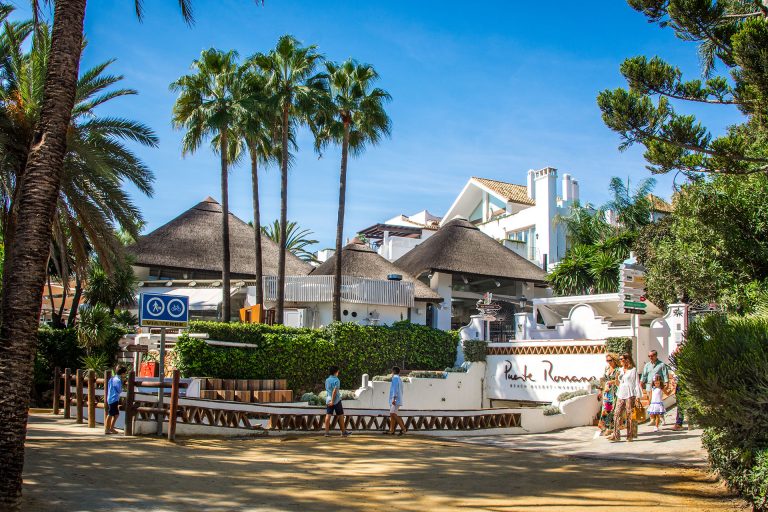
Marbella’s citywide average asking price sits at roughly €6,000–6,300 per m² in early-to-mid 2026, though the figure varies a lot depending on which data source and which exact boundary is used. The Golden Mile is the most expensive zone, averaging around €7,000+ per m², and its most exclusive micro-market — Puente Romano — has recorded fully refurbished resale prices above €24,000 per m², with some individual units trading well above €40,000 per m². Sierra Blanca and Cascada de Camoján villas regularly clear €15,000 per m². At the accessible end, San Pedro de Alcántara offers entry around €5,200–5,300 per m².
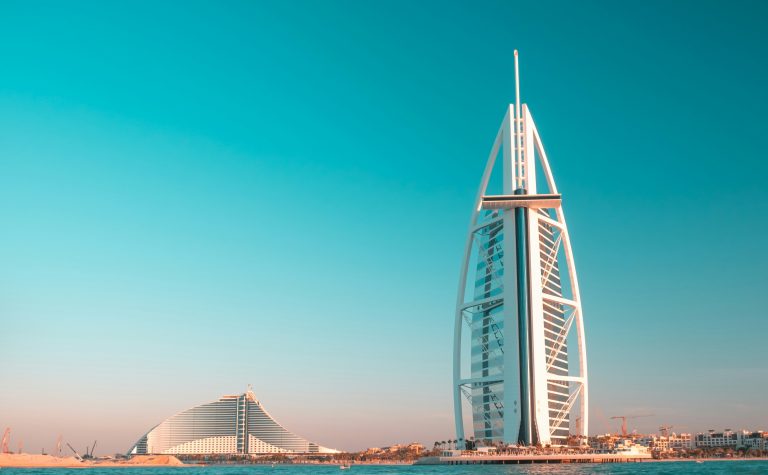
Dubai’s citywide median is lower in relative terms — roughly AED 18,000–20,000 per m² (around €4,000–5,000 per m² at recent exchange rates) — but the spread between mass-market and prime is enormous. Prime addresses like Palm Jumeirah, Downtown Dubai, DIFC, and Emirates Hills command AED 32,000 to over AED 75,000 per m², while budget communities like International City or Dubai South can sit as low as AED 8,600–15,600 per m².
Price per m²: Marbella vs. Dubai, by market tier
Asking/resale prices, early–mid 2026. Scale capped at €25,000/m² — Puente Romano’s top units (€40,000+/m²) run off the chart, shown as a hatched marker.
* Converted from AED (8,600–15,600 AED/m² budget; 32,000–75,000+ AED/m² prime) at approximate recent exchange rates. Figures vary meaningfully by data source and exact zone boundaries — treat as directional, not precise.
The takeaway: at the very top end, the two markets are closer than people assume — Puente Romano and Palm Jumeirah both operate in rarefied, scarcity-driven pricing tiers. But Dubai’s overall market is wider and more segmented, with far more affordable entry points feeding into the same citywide average, while Marbella’s supply is tightly constrained by geography and planning restrictions, which is what keeps its floor price higher.
Rental Yields Compared
This is where the two markets diverge sharply.
Dubai’s citywide gross rental yield averages around 6.7–7% for apartments, with mid-market and emerging communities (JVC, Dubai Investments Park, Discovery Gardens) often delivering 9–10% gross. Villas run lower, typically 5–6%. Even at the low end, Dubai comfortably outperforms most mature global cities on paper yield.
Marbella doesn’t compete on annual rental yield in the same way — long-term lets in prime areas typically yield in the low-to-mid single digits. Where Marbella pulls ahead is short-term and seasonal rental income: well-located luxury villas can generate €5,000–€15,000 per week in peak season (June to September), which materially changes the annual return picture for owners willing to manage a holiday-let strategy rather than a long-term tenancy.
Rental yields compared: Dubai vs. Marbella
Annual gross yield, apartments and villas, 2026. Marbella’s short-term summer letting income runs on a separate scale — see below.
single digits
The takeaway: if pure income yield is the goal, Dubai wins on paper — mid-market communities comfortably clear 9–10% gross. If the strategy includes personal use plus a strong summer letting season, Marbella’s short-term rental economics close much of that gap, but require more active, hands-on management.
Tax Residency and Golden Visa Rules
This is the section where a lot of comparison content goes out of date fast, so it’s worth being precise about where things stand in mid-2026.
Spain: the property-based Golden Visa — residency in exchange for a €500,000 real estate investment — was formally abolished by Organic Law 1/2025 and stopped accepting new applications on 3 April 2025. Anyone who already holds one can keep renewing it, but buying property in Spain today no longer creates a residency pathway on its own. Non-EU buyers who want to actually live in Spain now need a different route — the Non-Lucrative Visa (proof of passive income, no work allowed), the Digital Nomad Visa, the EU Blue Card for qualified employees, or standard work/family visas. You can still buy Spanish property freely as a foreign national with no restrictions; you just won’t get a residence permit as a byproduct of the purchase anymore.
Dubai/UAE: the property route to residency is still very much open. A minimum AED 2 million investment in approved freehold real estate qualifies for the 10-year renewable Golden Visa, with no employer sponsorship required and no minimum time spent in the country to keep it valid. There’s also a lighter two-year property investor visa, and as of April 2026 the UAE removed the fixed minimum property value that used to apply to that shorter-term route, widening access for smaller investors. On top of that, the UAE has no personal income tax and no capital gains tax on individual property sales.
Golden Visa & residency: Spain vs. UAE, mid-2026
Where the property-for-residency pathway stands after Spain’s abolition and the UAE’s latest rule change.
Closed
Open
The takeaway: for buyers whose primary goal is securing residency through property, Dubai is currently the more direct route by a wide margin. Spain remains attractive for lifestyle, EU access, and long-term capital appreciation, but property ownership alone no longer buys the right to live there.
Buyer Profile: Who Actually Buys in Each Market
Marbella’s buyer base has diversified well beyond its traditional British and Scandinavian retiree image. Gulf capital, along with US, Canadian, and broader Middle Eastern buyers, has become a visible force in the prime and ultra-prime segments over the past few years, often purchasing as a lifestyle asset and wealth-preservation play rather than a pure income investment.
Dubai’s buyer base is younger on average and split between two very different groups: global investors chasing yield in mid-market communities, and ultra-high-net-worth buyers — a substantial share of the world’s millionaire relocation flow in recent years has landed in the UAE — purchasing trophy real estate in Palm Jumeirah, Downtown, and similar addresses as much for tax residency as for the property itself.
Buyer segments Marbella vs. Dubai
Buyer segments and what’s driving each purchase, 2026.
Marbella
Lifestyle-led buyer base
Dubai
Tax- & yield-led buyer base
The takeaway: Marbella skews toward buyers prioritizing lifestyle and a European base; Dubai skews toward buyers prioritizing tax efficiency and yield — with intent converging sharply at the very top of both markets.
Legal Ownership Structures
Foreign buyers in Spain purchase freehold, full-title property with the same ownership rights as Spanish nationals — there is no restriction on foreign ownership, and the process runs through a notary with standard due diligence (NIE number, deposit contract, title search, notarial deed).
Dubai’s freehold system is more recent but now well established: designated freehold zones (which include almost every prime area investors target — Palm Jumeirah, Downtown, Dubai Marina, Business Bay, and others) allow full foreign ownership, registered through the Dubai Land Department. Outside these designated zones, foreign ownership is restricted or unavailable, so location matters more in Dubai simply to confirm freehold eligibility exists at all.
Freehold ownership: Spain vs. Dubai
Both markets welcome foreign buyers — but the geography of where full ownership applies is very different.
Spain
Nationwide freehold
Full ownership rights apply anywhere in the country — no restriction on foreign ownership.
Dubai
Zone-restricted freehold
Full ownership only inside designated freehold zones, registered via the Dubai Land Department.
These cover almost every prime area investors target — but outside designated zones, foreign ownership is restricted or unavailable. Always confirm freehold eligibility before committing to a property.
The takeaway: both markets are freehold-friendly for foreigners, but Spain’s ownership rights apply nationwide while Dubai’s apply only within specific zones — worth double-checking before falling in love with a property outside a designated freehold area.
Lifestyle and Climate
Marbella offers a genuine four-season Mediterranean climate — warm, dry summers and mild winters that rarely require heavy heating or, more importantly, constant air conditioning. Outdoor living, walkable old town streets, and a slower pace define much of the appeal, alongside golf, beach clubs, and easy access to the rest of Europe.
Dubai’s climate is a different proposition entirely: extremely hot summers (regularly 40°C+) push much of daily life indoors or into air-conditioned environments for several months of the year, with the more temperate window running roughly October to April. Life in Dubai leans towards a curated, indoor-outdoor luxury built around malls, marinas, and beach clubs engineered for the climate rather than in spite of it.
Both destinations sell a sunshine lifestyle — but how much of the year that sunshine translates into outdoor living looks very different.
Marbella
Four-season Mediterranean climate
Warm, dry summers and mild winters — rarely enough to need heavy heating or, more importantly, constant air conditioning.
Dubai
Climate-engineered luxury
Extreme summer heat pushes daily life indoors for several months a year — life leans towards a curated, indoor-outdoor luxury built for the climate.
Which Market Fits Your Investment Goals?
| Factor | Marbella | Dubai |
|---|---|---|
| Citywide avg. price/m² | ~€6,000–6,300 | ~€4,000–5,000 (AED 18,000–20,000) |
| Prime price/m² | €7,000–24,000+ (Golden Mile/Puente Romano) | AED 32,000–75,000+ (Palm Jumeirah, Downtown) |
| Typical gross rental yield | Low-single-digit long-term; strong seasonal short-let income | 6.5–10% citywide, higher in mid-market areas |
| Residency via property purchase | No — Golden Visa closed to new applicants since April 2025 | Yes — AED 2M for 10-year Golden Visa |
| Income/capital gains tax on property | Applies under Spanish tax law | None — no personal income or capital gains tax |
| Ownership structure | Freehold nationwide for foreigners | Freehold within designated zones only |
| Climate | Mediterranean, mild year-round | Hot summers, temperate Oct–Apr |
Neither market is objectively “better” — they solve different problems. Dubai is the stronger choice for buyers optimizing for yield, tax efficiency, and a direct residency pathway. Marbella is the stronger choice for buyers optimizing for lifestyle, EU access, and long-term capital preservation in a supply-constrained market. Increasingly, the two aren’t mutually exclusive: a growing number of buyers are holding property in both, using Dubai for tax residency and income, and Marbella for the summer months and long-term European foothold.
Curious how Marbella stacks up against other global luxury markets? See our full comparison of Marbella vs the World across five international destinations.
Cost of Buying Property in Nueva Andalucía: Real Estate Market Insights
Marbella Beachfront Property Prices: The Golden Mile vs. Marbella East
Best Golf Communities on the Costa del Sol for Property Buyers
Estepona vs Benahavís – Which Costa del Sol Hotspot Fits Your Property Goals?